
Fluid, piping & valves
Quick-release couplings
Quick-release couplings for hydraulic and pneumatic lines, connecting and disconnecting hoses by hand with spring-loaded ball latching and valves that close automatically when the halves are separated.
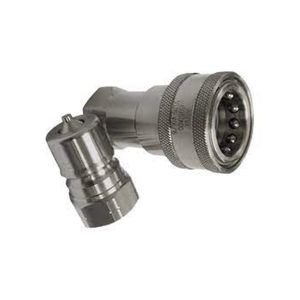
Overview
A quick-release coupling has two halves, a coupler and a nipple or adaptor. Pushing them together engages a ring of locking balls; pulling back the knurled sleeve releases them. In single shut-off couplings one half closes on disconnection; in double shut-off couplings both halves close, limiting fluid loss and air entry. Coupled halves can rotate under pressure, which helps avoid hose torsion. Balanced poppet springs and calibrated flow passages aim to keep pressure drop low. Versions include flat-face, push-pull, single and double check valve, and high-pressure designs, in carbon steel or stainless steel with threaded ends.
Selecting quick-release couplings
Choose single or double shut-off based on how much spillage or air ingress is acceptable on disconnection. Match the coupling size to the hose and flow, confirm the working pressure and the end thread, and check that body and seal materials suit the fluid. Couplings from different profiles do not usually mate.
Range overview
- Types and variants
- Hydraulic Quick-Release Couplings
- Single Check Valve Couplings
- Double Check Valve Couplings
- Flat-Face Couplings
- Push-Pull Couplings
- High-Pressure Quick-Release Couplings
- Male x Hose Couplings
- Materials and grades
- Carbon Steel (Zinc Plated)
- Stainless Steel
- SS 304
- SS 316
- Size range
- 1/2 in to 3 in
- High-Pressure Coupling: 1/4 in to 2 in
- Pressure / temperature
- 10000 psi working pressure (high-pressure coupling)
- Connections and interfaces
- Threaded
- Female Thread
- Coupler and Adaptor Halves
- Features
- Spring-Loaded Ball Latching
- Automatic Shut-Off on Disconnection
- Rotates Under Pressure
- Knurled Push-Pull Sleeve
Exact specifications depend on the variant, material and size. Confirm ratings and certification against the datasheet or with our engineers before ordering.
Applications
- Hydraulic Lines
- Pneumatic Lines
- Mobile Machinery Attachments
- Gas Lines
Industries
- Construction
- Agriculture
- Hydraulics
Information that speeds up a quotation
Share what you know. Anything you are unsure of can be marked “not known” — our engineers will help confirm it.
- Nominal size
- Pressure class
- Material
- End connection
- Standard
- Temperature
- Media
- Drawing
- Certification
Need a datasheet?
Add this family to your enquiry list and mention the variant — we will send the relevant technical documents.
Piping and hydraulic connections
Related and alternative families
Pipe fittings and flanges
Pipe fittings and flanges for process and utility piping, from butt-weld and forged fittings to slip-on, weld-neck, blind and threaded flanges, in…
Stainless steel butt-weld fittings
Stainless steel butt-weld pipe fittings, including bends, elbows, crosses and stub ends, for changing direction, branching or reducing welded process piping in…
Forged threaded and socket-weld fittings
Forged socket-weld and threaded pipe fittings for small-bore process lines, including elbows, couplings, half couplings, connectors, outlets and nipples in stainless, duplex…
Stainless steel seamless pipes and tubes
Stainless steel seamless and welded pipes and tubes for hydraulic, instrumentation and process lines, in 304 and 316 grades, with pickled, polished…
Hydraulic SAE flanges
Hydraulic SAE four-bolt flanges in Code 61 and Code 62 patterns, with one-piece flanges and split flange clamps for connecting hose ends,…
Hydraulic tube clamps
Hydraulic tube clamps in light, heavy and double-hole series for supporting and securing hydraulic tube and pipe runs, with polypropylene or polyamide…
Frequently asked questions
Should I use a single or double shut-off coupling?
A single shut-off coupling closes only one half on disconnection, so the other side can drain. A double shut-off coupling closes both halves, limiting spillage and air entry, which is useful on hydraulic attachments that are changed often. Choose based on the fluid, how often the line is broken and housekeeping needs.
What information is needed for a coupling quote?
Give the coupling style, size, end thread type and size, working pressure, fluid, material, and whether you need both halves or only one. If the coupling must mate with an existing half, send a sample or photograph so the profile can be checked.
Ready to specify quick-release couplings?
Send the details you have — quantities, sizes, drawings or a part number. Unknowns are fine.