
Fluid, piping & valves
Stainless steel butt-weld fittings
Stainless steel butt-weld pipe fittings, including bends, elbows, crosses and stub ends, for changing direction, branching or reducing welded process piping in austenitic and duplex grades.
Overview
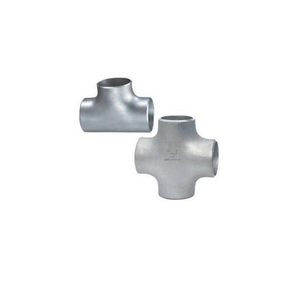
Butt-weld fittings are bevelled at each end and welded directly to the pipe, giving a continuous wall and a smooth bore. The range covers pipe bends and seamless bends, long-radius, short-radius and 45-degree elbows, equal crosses, tees, reducers, end caps, return bends and long-pattern stub ends for lap-joint flanges. Austenitic grades 304, 304L, 316 and 316L are standard. Duplex 2205 is offered in sizes from 1/2 in to 24 in NB across schedules 10S to XXS. Welded and seamless forms are both available; seamless construction is less common in larger diameters.
Selecting butt-weld fittings
Match the fitting to the pipe: nominal size, wall schedule and material grade should all agree with the piping specification. Choose the elbow radius to suit layout and flow, and confirm whether seamless or welded construction is required. For seawater, chlorides or stress-corrosion concerns, discuss duplex options.
Range overview
- Types and variants
- Pipe Bends
- Seamless Pipe Bends
- Long and Short Radius Elbows
- 45 Degree Elbows
- Equal Crosses
- Tees
- Reducers
- Long-Pattern Stub Ends
- End Caps
- Return Bends
- Materials and grades
- SS 304
- SS 304L
- SS 316
- SS 316L
- Duplex 2205 (UNS S31803/S32205)
- Size range
- 1/2 in to 3 in (Standard Range)
- Duplex: 1/2 in to 24 in NB
- Equal Cross Wall: 2 mm to 5 mm
- Pressure / temperature
- Schedules 10S, 40S, 80S, 160S, XXS (duplex range)
- Connections and interfaces
- Butt-Weld
- Standards referenced
- ASME B16.9
- ASME B16.28
- MSS SP-43
- Features
- Welded and Seamless Construction
- Polished Finish
Exact specifications depend on the variant, material and size. Confirm ratings and certification against the datasheet or with our engineers before ordering.
Applications
- Heat Exchangers
- Condensers
- Seawater Equipment
- Offshore Drilling
- Gas Processing
- Specialty Chemicals
Industries
- Oil and gas
- Power generation
- Petrochemical
- Pharmaceutical
- Pulp and paper
- Marine
Information that speeds up a quotation
Share what you know. Anything you are unsure of can be marked “not known” — our engineers will help confirm it.
- Nominal size
- Pressure class
- Material
- End connection
- Standard
- Temperature
- Media
- Drawing
- Certification
Need a datasheet?
Add this family to your enquiry list and mention the variant — we will send the relevant technical documents.
Piping and hydraulic connections
Related and alternative families
Pipe fittings and flanges
Pipe fittings and flanges for process and utility piping, from butt-weld and forged fittings to slip-on, weld-neck, blind and threaded flanges, in…
Forged threaded and socket-weld fittings
Forged socket-weld and threaded pipe fittings for small-bore process lines, including elbows, couplings, half couplings, connectors, outlets and nipples in stainless, duplex…
Stainless steel seamless pipes and tubes
Stainless steel seamless and welded pipes and tubes for hydraulic, instrumentation and process lines, in 304 and 316 grades, with pickled, polished…
Hydraulic SAE flanges
Hydraulic SAE four-bolt flanges in Code 61 and Code 62 patterns, with one-piece flanges and split flange clamps for connecting hose ends,…
Hydraulic tube clamps
Hydraulic tube clamps in light, heavy and double-hole series for supporting and securing hydraulic tube and pipe runs, with polypropylene or polyamide…
Quick-release couplings
Quick-release couplings for hydraulic and pneumatic lines, connecting and disconnecting hoses by hand with spring-loaded ball latching and valves that close automatically…
Frequently asked questions
What should a butt-weld fittings enquiry include?
Give the fitting type, nominal size, schedule or wall thickness, material grade, whether seamless or welded construction is required, and the dimensional standard. For reducers and reducing tees state both sizes. Quantities and documentation needs complete the enquiry. You can request material test certificates.
When is duplex stainless steel considered instead of 316?
Duplex 2205 is often considered where chloride pitting or stress corrosion cracking is a risk, such as seawater, desalination and some chemical service, or where its higher strength allows thinner walls. Suitability depends on media, temperature and welding procedures, so discuss the service conditions before selecting it.
Ready to specify stainless steel butt-weld fittings?
Send the details you have — quantities, sizes, drawings or a part number. Unknowns are fine.