
Dust control & spray
Tank cleaning nozzles and rotary heads
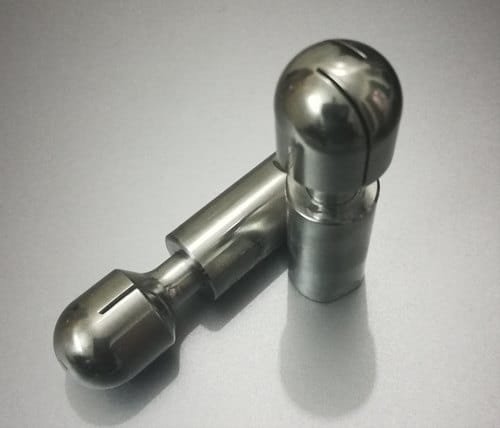
Tank cleaning nozzles and rotary heads clean the inside of process tanks, vessels and reactors in clean-in-place or manual cleaning, using rotary jets, revolving jets, rotating or static spray balls and static nozzles.
Overview
Tank cleaning devices are installed through a tank opening or permanently mounted, and spray cleaning liquid over the internal surfaces. Static spray balls rely on flow and wetting, and suit smaller tanks with lighter soiling. Rotating spray balls add movement for better coverage. Rotary jet and revolving jet heads use concentrated jets that index around the tank, giving impact cleaning in larger vessels and with heavier residues.
Static spray balls are available with 360° coverage or 180° upward or downward patterns. Materials include SS 304, SS 316, SS 316L, PTFE and food-contact polymers. Typical uses are CIP in food, beverage and brewery plants, pharmaceutical reactors, chemical mixing tanks, fermentation vessels and storm or retention tanks.
Selecting a tank cleaning device
Consider tank diameter and height, internal fittings that may shadow the spray, type of residue, cleaning cycle time, available flow and pressure, cleaning liquid and temperature, hygienic requirements, inlet size and thread, and whether the device is permanently installed or inserted for each clean.
Range overview
- Types and variants
- Rotary Jet Head
- Revolving Jet Head
- Rotating Spray Ball
- PTFE Rotating Spray Ball
- Static Spray Ball 360°
- Static Spray Ball 180° Up or Down
- Static Tank Cleaning Nozzle
- Materials and grades
- SS 304
- SS 316
- SS 316L
- PTFE
- Food-Contact Polymers
- Size range
- Inlet Sizes: 1-1/2 in and 3 in
- Connections and interfaces
- NPT or BSPT Female
- Features
- Rotating and Static Designs
- Impingement Cleaning With Rotary Jets
- Full or Partial Spray Coverage
- Suitable for CIP or Manual Cleaning
Exact specifications depend on the variant, material and size. Confirm ratings and certification against the datasheet or with our engineers before ordering.
Applications
- Clean-in-Place (CIP)
- Process Tanks
- Fermentation Vessels
- Reactors
- Chemical Mixing Tanks
- Storm and Retention Tanks
Industries
- Food and beverage
- Brewing
- Pharmaceuticals
- Chemical
- Wastewater
Information that speeds up a quotation
Share what you know. Anything you are unsure of can be marked “not known” — our engineers will help confirm it.
- Flow rate
- Pressure
- Pattern
- Angle
- Droplet size
- Material
- Connection
- Liquid
- Temperature
Need a datasheet?
Add this family to your enquiry list and mention the variant — we will send the relevant technical documents.
Industrial spray products
Related and alternative families
Flat fan spray nozzles
Flat fan spray nozzles produce a flat, sheet-like spray with a defined angle, used where liquid must be applied evenly along a…
Full cone spray nozzles
Full cone spray nozzles produce a solid, cone-shaped spray that covers a round or square area completely, used for gas cooling and…
Hollow cone spray nozzles
Hollow cone spray nozzles produce a ring-shaped spray with the liquid concentrated at the edge of the cone, giving fine atomisation at…
Air-atomizing spray nozzles
Air-atomizing spray nozzles mix liquid with compressed air to produce fine droplets at relatively low liquid pressure, used for coating, cooling, humidification…
Mist and dry-fog nozzles
Mist and dry-fog nozzles atomise water, or water with compressed air, into very fine droplets for dust suppression, fogging and humidification at…
Spiral spray nozzles
Spiral spray nozzles shear liquid off a series of spiral turns to form a full or hollow cone spray, giving high flow…
Frequently asked questions
What information is needed to select a tank cleaning head?
Provide the tank diameter and height, the size and position of the access opening, internal fittings such as agitators or baffles, the type of residue, cleaning liquid and temperature, available flow and pressure, any hygienic requirements and the inlet thread. A tank drawing helps check coverage.
Should I use a static spray ball or a rotary jet head?
Static spray balls are simple, with no moving parts, and suit smaller tanks and residues that rinse off easily. Rotating spray balls improve coverage. Rotary and revolving jet heads give higher impact and reach for larger tanks or stubborn residues. Tank size, soil type and cycle time decide the choice.
Ready to specify tank cleaning nozzles and rotary heads?
Send the details you have — quantities, sizes, drawings or a part number. Unknowns are fine.