
Dust control & spray
Spiral spray nozzles
Spiral spray nozzles shear liquid off a series of spiral turns to form a full or hollow cone spray, giving high flow at low pressure with an open, unobstructed passage and no internal parts.
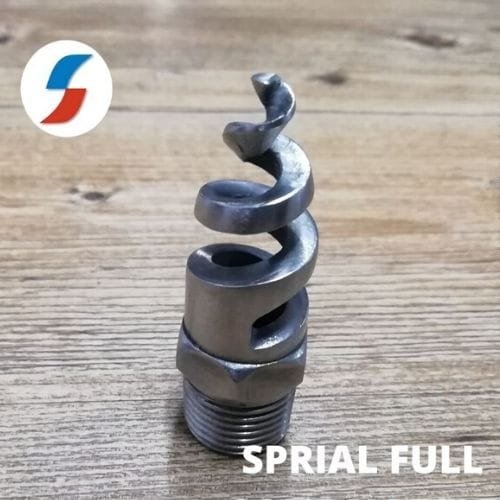
Overview
In a spiral nozzle, liquid flows straight through an open bore and strikes a tapering helical surface. Each turn of the spiral shears off part of the flow, and the layers combine into a full cone or hollow cone pattern. With no internal vanes, the nozzle offers a large free passage and handles liquids containing some solids. Spiral nozzles are available in full cone and hollow cone forms, in a range of spray angles and in metals and plastics such as stainless steel and PP. Typical duties are flue gas and ship exhaust gas scrubbing, gas cooling, washing and fire protection, where large volumes must be sprayed with modest pump pressure.
Selecting a spiral nozzle
Consider the flow required, available pressure, spray angle and coverage across the vessel or duct, solids content of the liquid, liquid temperature and chemistry, nozzle material and connection size and thread. For scrubbers, nozzle spacing and overlap across the cross-section are checked as part of the selection.
Range overview
- Types and variants
- Spiral Full Cone Nozzle
- Spiral Hollow Cone Nozzle
- PP Spiral Nozzle
- Stainless Steel Full Cone Spiral Nozzle
- Materials and grades
- Brass
- SS 304
- SS 316
- Mild Steel
- Hastelloy
- Titanium
- PVC
- Nylon
- PVDF
- PP
- Pressure / temperature
- Spray Angles: 60°, 90°, 120°, 150°, 170°
- Connections and interfaces
- NPT, BSPT or BSP Threads
- Features
- No Internal Parts
- Large Free Passage
- High Flow at Low Pressure
- Full and Hollow Cone Patterns
Exact specifications depend on the variant, material and size. Confirm ratings and certification against the datasheet or with our engineers before ordering.
Applications
- Flue Gas Scrubbing
- Exhaust Gas Scrubbing
- Gas Cooling
- Washing
- Fire Protection
Industries
- Power generation
- Chemical
- Marine
- Steel
Information that speeds up a quotation
Share what you know. Anything you are unsure of can be marked “not known” — our engineers will help confirm it.
- Flow rate
- Pressure
- Pattern
- Angle
- Droplet size
- Material
- Connection
- Liquid
- Temperature
Need a datasheet?
Add this family to your enquiry list and mention the variant — we will send the relevant technical documents.
Industrial spray products
Related and alternative families
Flat fan spray nozzles
Flat fan spray nozzles produce a flat, sheet-like spray with a defined angle, used where liquid must be applied evenly along a…
Full cone spray nozzles
Full cone spray nozzles produce a solid, cone-shaped spray that covers a round or square area completely, used for gas cooling and…
Hollow cone spray nozzles
Hollow cone spray nozzles produce a ring-shaped spray with the liquid concentrated at the edge of the cone, giving fine atomisation at…
Air-atomizing spray nozzles
Air-atomizing spray nozzles mix liquid with compressed air to produce fine droplets at relatively low liquid pressure, used for coating, cooling, humidification…
Mist and dry-fog nozzles
Mist and dry-fog nozzles atomise water, or water with compressed air, into very fine droplets for dust suppression, fogging and humidification at…
Tank cleaning nozzles and rotary heads
Tank cleaning nozzles and rotary heads clean the inside of process tanks, vessels and reactors in clean-in-place or manual cleaning, using rotary…
Frequently asked questions
When is a spiral nozzle a good choice?
Spiral nozzles are often considered where large flows must be sprayed at low pressure, or where the liquid carries solids that could block nozzles with internal vanes. Scrubbers, gas coolers and washing duties are common examples. Coverage, droplet size and pressure drop should still be checked for the specific duty.
What should I send to size spiral nozzles?
Send the total flow and number of nozzles, available pressure, required spray angle, vessel or duct dimensions and nozzle positions, liquid composition, solids content and temperature, preferred material and connection size and thread. For replacements, the existing nozzle size and marking are useful.
Ready to specify spiral spray nozzles?
Send the details you have — quantities, sizes, drawings or a part number. Unknowns are fine.