
Dust control & spray
Hollow cone spray nozzles
Hollow cone spray nozzles produce a ring-shaped spray with the liquid concentrated at the edge of the cone, giving fine atomisation at low pressure for scrubbing, cooling, washing, dust pre-wetting and humidification.
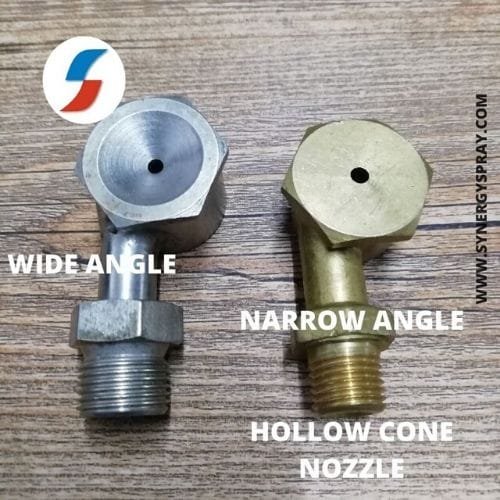
Overview
A hollow cone nozzle uses a tangential inlet or swirl chamber to spin the liquid, which leaves the orifice as a thin conical sheet and breaks into droplets around a ring. Because the liquid is spread thinly, hollow cone nozzles give relatively small droplets at modest pressure and a large free passage compared with many fine-spray designs. Wide-angle versions spread the spray broadly at short distances, narrow-angle versions concentrate it, and high-pressure configurations are available for finer atomisation. Typical duties include gas scrubbing, cooling and quenching, washing and rinsing, pre-wetting of dusty material and humidification.
Selecting a hollow cone nozzle
Consider flow and pressure, spray angle, droplet size needed for the process, the liquid and any suspended solids, temperature and chemical compatibility of the nozzle material, and the connection type. For gas scrubbing and cooling, coverage across the duct or vessel cross-section is also checked.
Range overview
- Types and variants
- Wide-Angle Hollow Cone Nozzle
- Narrow-Angle Hollow Cone Nozzle
- High-Pressure Hollow Cone Nozzle
- Materials and grades
- Brass
- SS 304
- SS 316
- Coated Mild Steel
- Hastelloy
- Titanium
- PVC
- Nylon
- PVDF
- PP
- Pressure / temperature
- Spray Angles: 30–120° (Narrow 30–60°, Wide 90–120°)
- Flow: 2–170 L/min at 2–10 bar
- Connections and interfaces
- 1/8 in to 1/2 in NPT, BSPT or BSP
- Male and Female Threads
- Features
- Ring-Shaped Spray Pattern
- Fine Atomisation at Low Pressure
- Wide and Narrow Angle Options
Exact specifications depend on the variant, material and size. Confirm ratings and certification against the datasheet or with our engineers before ordering.
Applications
- Gas Scrubbing
- Cooling and Quenching
- Washing and Rinsing
- Dust Pre-Wetting
- Humidification
Industries
- Chemical
- Power generation
- Steel
- Mining
- Food processing
Information that speeds up a quotation
Share what you know. Anything you are unsure of can be marked “not known” — our engineers will help confirm it.
- Flow rate
- Pressure
- Pattern
- Angle
- Droplet size
- Material
- Connection
- Liquid
- Temperature
Need a datasheet?
Add this family to your enquiry list and mention the variant — we will send the relevant technical documents.
Industrial spray products
Related and alternative families
Flat fan spray nozzles
Flat fan spray nozzles produce a flat, sheet-like spray with a defined angle, used where liquid must be applied evenly along a…
Full cone spray nozzles
Full cone spray nozzles produce a solid, cone-shaped spray that covers a round or square area completely, used for gas cooling and…
Air-atomizing spray nozzles
Air-atomizing spray nozzles mix liquid with compressed air to produce fine droplets at relatively low liquid pressure, used for coating, cooling, humidification…
Mist and dry-fog nozzles
Mist and dry-fog nozzles atomise water, or water with compressed air, into very fine droplets for dust suppression, fogging and humidification at…
Spiral spray nozzles
Spiral spray nozzles shear liquid off a series of spiral turns to form a full or hollow cone spray, giving high flow…
Tank cleaning nozzles and rotary heads
Tank cleaning nozzles and rotary heads clean the inside of process tanks, vessels and reactors in clean-in-place or manual cleaning, using rotary…
Frequently asked questions
How does a hollow cone nozzle differ from a full cone nozzle?
A hollow cone nozzle places the liquid in a ring at the edge of the spray, which generally produces smaller droplets at the same pressure. A full cone nozzle fills the whole circular area. Hollow cone suits scrubbing, cooling and humidification where atomisation matters; full cone suits even area coverage.
What should I tell you to select a hollow cone nozzle?
Give the flow per nozzle, operating pressure, preferred spray angle, distance to the target or duct size, the liquid and its temperature, any solids content, preferred material and thread type and size. If replacing an existing nozzle, a sample or the existing part marking helps.
Ready to specify hollow cone spray nozzles?
Send the details you have — quantities, sizes, drawings or a part number. Unknowns are fine.