
Fluid, piping & valves
Needle valves
Instrument needle valves for fine flow regulation and isolation on gauge, transmitter, sampling and process lines, machined from bar stock or forgings in hex body, square body, angle, mini and integral or screwed bonnet designs.
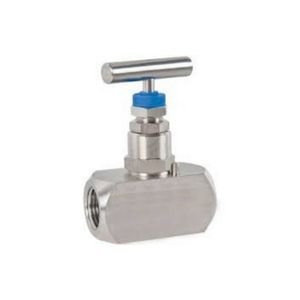
Overview
A needle valve uses a slender tapered stem seating in a small orifice, so the flow can be shut off positively or adjusted in small steps. This makes it suitable for isolating instruments, damping pressure surges at gauges and regulating low flows of liquid or gas. The standard V-type stem gives tight shut-off; regulating stems and soft-seat versions are available.
Series include hex body and square body bar-stock valves, angle pattern valves, mini valves with round or T-bar handles, and integral bonnet and screwed bonnet designs. Sizes run from 1/8 in to 1 in. Ends include male and female NPT, BSP, BSPT, socket weld and double-ferrule tube ends. PTFE packing is standard, with graphite packing for higher temperatures.
Selecting a needle valve
Start with pressure, temperature and media, which determine body material and packing. Then choose the pattern (straight or angle), the stem type (shut-off, regulating or soft seat) and the end connections at inlet and outlet. For sour service, ask about materials to NACE MR0175.
Range overview
- Types and variants
- Hex Body Needle Valves
- Square Body Needle Valves
- Angle Pattern Needle Valves
- Mini Needle Valves
- Integral Bonnet Needle Valves
- Screwed Bonnet Needle Valves
- Male x Female Needle Valves
- Tube-End Needle Valves
- Forged Needle Valves
- Ultra High-Pressure Needle Valves
- Materials and grades
- SS 304/304L
- SS 316/316L
- Carbon Steel (ASTM A105)
- Alloy Steel F11
- Monel 400
- Hastelloy
- Brass
- Size range
- 1/8 in to 1 in
- Mini Valve: 1/4 in End Connection
- Pressure / temperature
- Up to 6000 psig working pressure (standard)
- PTFE packing: up to 232 °C (450 °F)
- Graphite packing: up to 371 °C (700 °F)
- Pneumatic seat test: 1000 psi nitrogen
- Hydrostatic seat test: 1.1 x working pressure
- Hydrostatic shell test: 1.5 x working pressure
- Connections and interfaces
- Male NPT
- Female NPT
- BSP
- BSPT
- ANPT (On Request)
- Socket Weld
- Double-Ferrule Tube End
- Standards referenced
- NACE MR0175 (materials on request)
- Features
- Bar-Stock or Forged Body
- V-Type Stem Standard
- Regulating and Soft-Seat Stem Options
- Heat Code Traceability
- Round or T-Bar Handles
Exact specifications depend on the variant, material and size. Confirm ratings and certification against the datasheet or with our engineers before ordering.
Applications
- Instrument Isolation
- Gauge Surge Damping
- Flow Regulation
- Sampling Systems
- Analytical Instruments
- Process Systems
Industries
- Chemical
- Petrochemical
- Oil and gas
- Refining
- Pharmaceutical
- Steel
- Pulp and paper
- Water treatment
- Shipbuilding
Information that speeds up a quotation
Share what you know. Anything you are unsure of can be marked “not known” — our engineers will help confirm it.
- Valve type
- Port
- Flow direction
- Pressure
- Temperature
- Cv
- Material
- End connection
- Actuation
- Standard
Need a datasheet?
Add this family to your enquiry list and mention the variant — we will send the relevant technical documents.
Valves and manifolds
Related and alternative families
Industrial ball valves
Quarter-turn ball valves for shut-off duty on oil, gas, water, air and fuel lines, from compact instrument valves to high-pressure models, in…
Check valves
Check (non-return) valves that let flow pass in one direction and close automatically against reverse flow, from instrument-size poppet and piston check…
Block valves
Block valves for isolating process connections to instruments and sample points, including single and double block-and-bleed valves, monoflange valves and block-and-bleed gauge…
Bleed valves
Instrument bleed valves for venting trapped signal-line pressure to atmosphere before an instrument is removed or during calibration, used on multi-valve manifolds,…
Double block-and-bleed assemblies
Double block-and-bleed assemblies and multi-valve manifolds that give two-barrier isolation with a vent between, for safe maintenance and calibration of pressure gauges,…
Gauge root valves
Gauge root valves for the first isolation point between a process tapping and its impulse line, gauge or transmitter, in bar-stock construction…
Related solutions and guides
Frequently asked questions
When should I use a needle valve rather than a ball valve?
Use a needle valve when you need fine adjustment of flow or a compact, multi-turn isolation valve for an instrument. A ball valve opens fully with a quarter turn and is better for quick on-off isolation of a line. Needle valves are often used where gauges need protection from sudden pressure changes.
What information is needed to quote for needle valves?
Give the valve series or pattern, size, end connections at inlet and outlet, body material, packing, stem type, maximum pressure and temperature, media and quantity. Mention NACE or other material requirements. You can request material test certificates and heat code traceability details.
Ready to specify needle valves?
Send the details you have — quantities, sizes, drawings or a part number. Unknowns are fine.