
Fluid, piping & valves
Industrial ball valves
Quarter-turn ball valves for shut-off duty on oil, gas, water, air and fuel lines, from compact instrument valves to high-pressure models, in lever-operated and panel-mounted versions with threaded or tube ends.
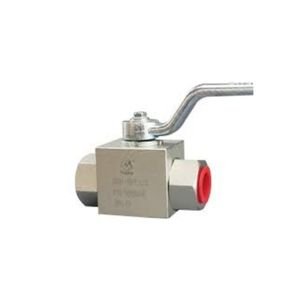
Overview
A ball valve opens and closes with a quarter turn of a bored ball, and the handle position shows at a glance whether the valve is open or shut. Ball valves are best suited to on-off service rather than throttling. Lever-operated versions use an internally loaded stem with a shoulder that retains the stem against blowout, and a large orifice to keep pressure drop low; panel-mounted versions have a mounting nut for fixing through a panel.
The range includes two-way and three-way valves, high-pressure valves in 1000 bar, 15000 psi and 20000 psi classes, and options such as 90-degree stops, position indicators, anti-static construction and metal back-up seats, in stainless steel and steel from 1/4 in to 2 in.
Selecting a ball valve
Confirm the pressure and temperature, the media, and the end connection (screwed thread or tube end) and size. Decide between two-way and three-way patterns and lever or panel mounting. For hazardous service, state any fire-safe or anti-static requirement so it can be confirmed.
Range overview
- Types and variants
- Lever-Operated Ball Valves
- Panel-Mounted Ball Valves
- Two-Way Ball Valves
- Three-Way Ball Valves
- 1000 Bar Ball Valves
- 15000 Psi Ball Valves
- 20000 Psi Ball Valves
- Flanged Ball Valves
- Materials and grades
- Stainless Steel
- Steel
- Size range
- 1/4 in to 2 in
- High-Pressure and Panel Valves: 1/4 in to 1 in
- Pressure / temperature
- 1000 bar (ball valve, as named)
- 15000 psi (ball valve, as named)
- 20000 psi (ball valve, 1/4 in to 1 in, as named)
- Connections and interfaces
- Screwed (Threaded)
- Tube End
- Flanged
- Features
- Quarter-Turn Operation
- Blowout-Resistant Stem (Lever Type)
- Panel Mounting Nut (Panel Type)
- 90 Degree Stops
- Position Indicators
- Metal Back-Up Seat Option
Exact specifications depend on the variant, material and size. Confirm ratings and certification against the datasheet or with our engineers before ordering.
Applications
- Shut-Off on Oil, Gas, Water, Air and Fuel Lines
- Instrument Isolation
- Panel-Mounted Instrument Systems
Industries
- Oil and gas
- Chemical
- Petrochemical
- Power generation
- Shipbuilding
Information that speeds up a quotation
Share what you know. Anything you are unsure of can be marked “not known” — our engineers will help confirm it.
- Valve type
- Port
- Flow direction
- Pressure
- Temperature
- Cv
- Material
- End connection
- Actuation
- Standard
Need a datasheet?
Add this family to your enquiry list and mention the variant — we will send the relevant technical documents.
Valves and manifolds
Related and alternative families
Needle valves
Instrument needle valves for fine flow regulation and isolation on gauge, transmitter, sampling and process lines, machined from bar stock or forgings…
Check valves
Check (non-return) valves that let flow pass in one direction and close automatically against reverse flow, from instrument-size poppet and piston check…
Block valves
Block valves for isolating process connections to instruments and sample points, including single and double block-and-bleed valves, monoflange valves and block-and-bleed gauge…
Bleed valves
Instrument bleed valves for venting trapped signal-line pressure to atmosphere before an instrument is removed or during calibration, used on multi-valve manifolds,…
Double block-and-bleed assemblies
Double block-and-bleed assemblies and multi-valve manifolds that give two-barrier isolation with a vent between, for safe maintenance and calibration of pressure gauges,…
Gauge root valves
Gauge root valves for the first isolation point between a process tapping and its impulse line, gauge or transmitter, in bar-stock construction…
Frequently asked questions
Can a ball valve be used for throttling?
Ball valves are designed for on-off service. Holding a standard ball valve partly open can erode the seats and lead to leakage. For flow regulation, a needle valve or a purpose-designed control valve is usually a better choice. Tell us how the flow needs to be controlled and we can suggest a suitable valve type.
What should I include in a ball valve enquiry?
State the valve pattern (two-way or three-way), size, end connections, body and seat materials, maximum pressure and temperature, media, operation (lever or panel mounted) and quantity. Mention any fire-safe, anti-static or testing requirements so they can be confirmed at quotation stage.
Ready to specify industrial ball valves?
Send the details you have — quantities, sizes, drawings or a part number. Unknowns are fine.