
Fluid, piping & valves
Check valves
Check (non-return) valves that let flow pass in one direction and close automatically against reverse flow, from instrument-size poppet and piston check valves with tube or threaded ends to dual-plate wafer check valves for larger lines.
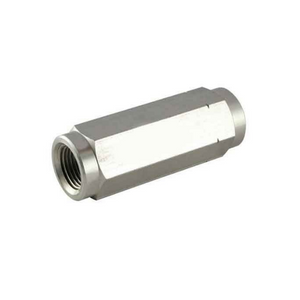
Overview
A check valve opens when upstream pressure exceeds the cracking pressure and closes when flow stops or reverses. It protects pumps and compressors from backflow, prevents contamination between systems and limits media loss if a downstream connection fails. Instrument check valves are listed from 1/8 in to 1 in with a choice of cracking pressure from 1/3 psi to 25 psi.
The range covers double-ferrule and single-ferrule tube-end check valves, piston check valves, threaded stainless steel non-return valves from 1/2 in to 2 in, high-pressure check valves, and dual-plate check valves in cast iron from DN 50 to DN 400 with wafer or flanged ends.
Selecting a check valve
Confirm the working pressure, media and temperature, then choose a cracking pressure that suits the system so the valve opens reliably without chattering. Select body material and end connections to match the line. For larger lines, check whether wafer or flanged dual-plate valves suit the pipe flange standard.
Range overview
- Types and variants
- Poppet Check Valves
- Piston Check Valves
- Double-Ferrule Check Valves
- Single-Ferrule Tube-End Non-Return Valves
- Stainless Steel Non-Return Valves
- High-Pressure Check Valves
- Dual-Plate Check Valves
- Materials and grades
- SS 316
- Stainless Steel
- Brass
- Mild Steel
- Carbon Steel
- Cast Iron
- Hastelloy C276
- Inconel 625
- Monel 400
- Size range
- Instrument Check Valves: 1/8 in to 1 in
- Non-Return Valves: 1/2 in to 2 in
- Dual-Plate: DN 50 to DN 400
- Pressure / temperature
- 6000 psi standard working pressure (instrument check valve)
- 10000 psi maximum working pressure (on request)
- Cracking pressure: 1/3 psi to 25 psi
- Connections and interfaces
- NPT
- BSPP
- BSPT
- Tube Ends
- Screwed
- Wafer
- Flanged
- Features
- Choice of Cracking Pressure
- Heat Code Traceability
- Tube-End and Threaded Options
- Customisable
Exact specifications depend on the variant, material and size. Confirm ratings and certification against the datasheet or with our engineers before ordering.
Applications
- Backflow Prevention
- Pump Outlet Protection
- Preventing Media Loss From Failed Connections
- Hydraulic Systems
Industries
- Chemical
- Power generation
- Oil and gas
Information that speeds up a quotation
Share what you know. Anything you are unsure of can be marked “not known” — our engineers will help confirm it.
- Valve type
- Port
- Flow direction
- Pressure
- Temperature
- Cv
- Material
- End connection
- Actuation
- Standard
Need a datasheet?
Add this family to your enquiry list and mention the variant — we will send the relevant technical documents.
Valves and manifolds
Related and alternative families
Industrial ball valves
Quarter-turn ball valves for shut-off duty on oil, gas, water, air and fuel lines, from compact instrument valves to high-pressure models, in…
Needle valves
Instrument needle valves for fine flow regulation and isolation on gauge, transmitter, sampling and process lines, machined from bar stock or forgings…
Block valves
Block valves for isolating process connections to instruments and sample points, including single and double block-and-bleed valves, monoflange valves and block-and-bleed gauge…
Bleed valves
Instrument bleed valves for venting trapped signal-line pressure to atmosphere before an instrument is removed or during calibration, used on multi-valve manifolds,…
Double block-and-bleed assemblies
Double block-and-bleed assemblies and multi-valve manifolds that give two-barrier isolation with a vent between, for safe maintenance and calibration of pressure gauges,…
Gauge root valves
Gauge root valves for the first isolation point between a process tapping and its impulse line, gauge or transmitter, in bar-stock construction…
Frequently asked questions
How do I choose the cracking pressure?
The cracking pressure is the upstream pressure at which the valve begins to open. Choose a value low enough that the system can open the valve easily, but high enough that the valve closes reliably and does not chatter at low flow. Tell us the normal operating pressure difference and flow and we can discuss suitable options.
What details are needed to quote for check valves?
Provide size, end connections, body and seal materials, cracking pressure, maximum working pressure and temperature, media, flow direction and quantity. For dual-plate valves give the DN size, flange standard and class. You can request material test certificates with the supply.
Ready to specify check valves?
Send the details you have — quantities, sizes, drawings or a part number. Unknowns are fine.