
Cooling, humidity & air
Animal and livestock cooling
Animal and livestock cooling uses evaporative misting and fogging in dairy and cattle sheds, poultry houses, piggeries, stables, kennels and similar buildings to help keep animals comfortable in hot weather.
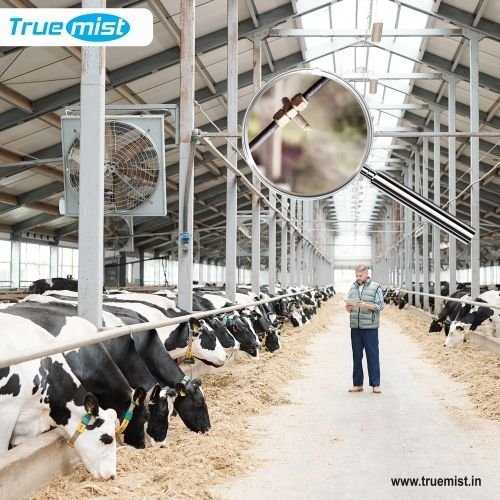
Overview
Livestock buildings can become very hot, and animals are sensitive to heat stress. Misting and fogging systems release fine droplets that evaporate into the air, cooling it, and work best together with existing fans or natural airflow that carry the cooled air through the shed. They can also help reduce dust and odour. High-pressure systems give finer droplets that evaporate faster and suit larger sheds, while low-pressure kits suit small areas. Layouts are configured for each building type: cow sheds and dairy farms, buffalo and goat sheds, poultry houses and hatcheries, pig farms, rabbit farms, horse stalls and stud farms, dog kennels and zoo enclosures.
Selecting a livestock cooling system
Consider the building type and dimensions, number and type of animals, existing fans and ventilation, climate and humidity, water quality, power supply, and how wet the floor and bedding can become. Nozzle placement and run times are set so mist evaporates above the animals.
Range overview
- Types and variants
- Dairy Farm Fogger System
- Cow Shed Misting System
- Poultry Misting System
- Pig Farm Misting System
- Rabbit Farm Misting System
- Horse Stall Misting System
- Dog Kennel Mist Cooling
- Low-Pressure Fogger Kits
- Features
- High-Pressure and Low-Pressure Options
- Works With Existing Fans
- Dust and Odour Reduction
- Simple Installation
Exact specifications depend on the variant, material and size. Confirm ratings and certification against the datasheet or with our engineers before ordering.
Applications
- Dairy and Cattle Sheds
- Poultry Houses
- Hatcheries
- Piggeries
- Stables and Stud Farms
- Kennels
- Zoos
Industries
- Livestock
- Dairy
- Poultry
- Agriculture
Information that speeds up a quotation
Share what you know. Anything you are unsure of can be marked “not known” — our engineers will help confirm it.
- Area
- Dimensions
- Indoor outdoor
- Temperature
- Relative humidity (RH)
- Target RH
- Water quality
- Ventilation
- Power
- Maintenance
Need a datasheet?
Add this family to your enquiry list and mention the variant — we will send the relevant technical documents.
Cooling and humidification
Related and alternative families
Industrial high-pressure mist cooling
Industrial high-pressure mist cooling uses pumps and fine nozzles to release water mist that evaporates into the air, providing evaporative cooling and…
Indoor mist cooling
Indoor mist cooling uses high-pressure pumps and fine anti-drip nozzles to release micron-sized droplets that evaporate quickly, cooling and humidifying indoor spaces…
Outdoor mist cooling
Outdoor mist cooling uses high-pressure misting lines or mist fans to create a cooler, more comfortable microclimate in patios, gardens, resorts, outdoor…
Adiabatic condenser and VRF pre-cooling
Adiabatic condenser and VRF pre-cooling places a line of misting nozzles in front of air-cooled condenser coils, chillers or VRF outdoor units,…
Industrial humidification systems
Industrial humidification systems add moisture to air using high-pressure fogging nozzles, or compressed-air dry fog, to hold humidity at the level a…
Textile spinning and weaving humidification
Textile spinning and weaving humidification uses high-pressure pumps and overhead mist nozzle lines to hold humidity in ginning, pressing, spinning and weaving…
Related solutions and guides
Frequently asked questions
What should I tell you about my shed?
Share the shed dimensions and roof height, the type and number of animals, existing fans or ventilation, the climate and typical humidity, water source and quality, and power supply. Photographs of the shed interior help us plan nozzle lines around fans, feeding and walkways.
High-pressure or low-pressure: which is right for livestock?
High-pressure systems produce finer droplets that evaporate more readily and suit larger sheds and humid conditions. Low-pressure kits are simpler and suit small areas such as kennels or individual stalls. Shed size, climate and budget guide the choice.
Ready to specify animal and livestock cooling?
Send the details you have — quantities, sizes, drawings or a part number. Unknowns are fine.