
Dust control & spray
Mist dust suppression
Mist dust suppression uses high-pressure pumps and fine misting nozzles to fill the air around a dust source with small water droplets that capture airborne particles before they spread.
Overview
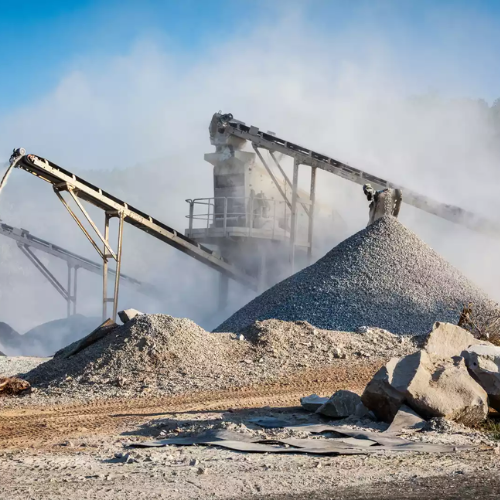
In a misting system, filtered water is pressurised by a pump unit and released through fine nozzles along pipelines, around equipment or at site perimeters. The fine droplets stay airborne long enough to collide with suspended dust and bring it down, while adding relatively little water to the material below. Systems can be fixed, with nozzle lines around crushers, haul roads, storage areas or boundaries, or portable for changing work fronts. A system normally comprises the pump unit, misting nozzles, high-pressure piping or tubing, water filtration and a control panel with manual and automatic modes, often PLC-based.
Selecting the right misting system
The choice between high-pressure and lower-pressure misting, fixed or portable layouts, and the number of nozzles depends on the dust source, area to be covered, wind exposure, water quality and quantity, available power supply, and whether additives such as surfactants are to be used. Filtration matters because fine nozzles are sensitive to suspended solids.
Range overview
- Types and variants
- High-Pressure Misting System
- Low-Pressure Misting System
- Fixed Misting System
- Portable Misting System
- Materials and grades
- Stainless Steel
- Nylon Tubing
- Pressure / temperature
- Power Supply: 220 V / 440 V
- Features
- Pump Unit With Water Filtration
- Fine Misting Nozzles
- PLC Control With Manual and Automatic Modes
- Suitable for Water or Water With Surfactants
Exact specifications depend on the variant, material and size. Confirm ratings and certification against the datasheet or with our engineers before ordering.
Applications
- Mines
- Haul Roads
- Crushers
- Construction Sites
- Material Storage Areas
- Waste Management Sites
- Ports
Industries
- Mining
- Quarrying
- Construction
- Cement
- Coal handling
- Ports
Information that speeds up a quotation
Share what you know. Anything you are unsure of can be marked “not known” — our engineers will help confirm it.
- Dust source
- Material
- Throughput
- Enclosure
- Water
- Compressed air
- Power
- Moisture limit
- Site layout
- Target
Need a datasheet?
Add this family to your enquiry list and mention the variant — we will send the relevant technical documents.
Dust suppression systems
Related and alternative families
Dry fog dust suppression
Dry fog dust suppression uses water and compressed air, atomised together through dry fog nozzles, to create a very fine fog that…
Wet sprinkler dust control
Wet sprinkler dust control applies water through a pressurised pipe network, sprinkler heads or rain guns to wet stockpiles, yards and haul…
Dust suppression at conveyor transfer points
Dust suppression at conveyor transfer points places spray, mist or dry fog nozzles at chutes, loading points and junction towers to control…
Crusher and screening dust suppression
Crusher and screening dust suppression controls dust at jaw, cone, impact and other crushers, screens, hoppers, chutes and stockpiles using water spray,…
Stockyard dust-control sprinklers
Stockyard dust-control sprinklers wet the surface of coal, ore, aggregate and other bulk stockpiles using fixed sprinkler networks, rain guns or fog…
Bulk material unloading dust suppression
Bulk material unloading dust suppression controls dust released at wagon tipplers, track hoppers, ground hoppers and loading points, using dry fog, mist…
Related solutions and guides
Frequently asked questions
What details help you size a misting system?
Share the dust source, area or length to be covered, site layout, prevailing wind direction, water source and quality, available power supply, and whether the system should be fixed or portable. Information on operating hours and preferred control (manual, timer, sensor or PLC) also helps us propose a pump, nozzle and filtration arrangement.
Why is water filtration important in a misting system?
Misting nozzles have small orifices, so suspended solids in the water can block them or wear them quickly. A suitable filtration stage before the pump protects the pump and nozzles and helps keep the spray pattern consistent. We can advise on filtration once we know your water source.
Ready to specify mist dust suppression?
Send the details you have — quantities, sizes, drawings or a part number. Unknowns are fine.