
Dust control & spray
Crusher and screening dust suppression
Crusher and screening dust suppression controls dust at jaw, cone, impact and other crushers, screens, hoppers, chutes and stockpiles using water spray, dry fog, fog cannons or perimeter fog lines placed close to each release point.
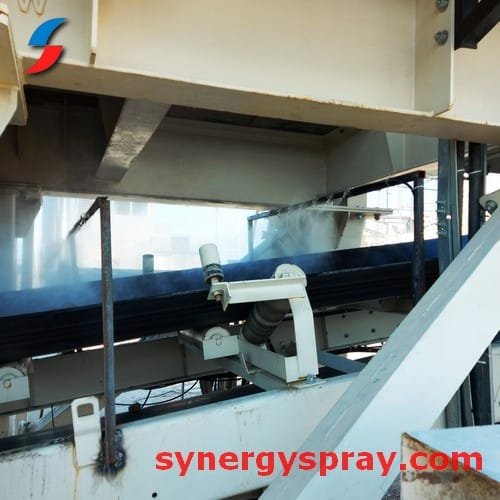
Overview
Crushing and screening plants release dust at the crusher feed and discharge, at screens, at conveyor transfer points and from stockpiles. Effective control means treating each source close to where dust is released rather than relying on a single general spray. Systems are configured site by site and may combine water spray bars, dry fog nozzles at enclosed points, mist curtains at transfer points, fog lines around the perimeter and fog or mist cannons over stockpiles. They can be operated from a central control board, with water alone or water mixed with a surfactant. Pre-filtered water, skirt boards at transfer points and, for cold conditions, an air or glycol purge are typical design points.
Selecting a crusher plant system
Consider crusher type (jaw, cone, gyratory, roll, HSI, hammer mill, sizer or feeder-breaker), throughput, rock or ore type and moisture limits, the degree of enclosure at each point, water and compressed-air availability, power supply and plant layout. A site evaluation helps decide which method suits each source.
Range overview
- Types and variants
- Water Spray System
- Dry Fog System
- Fog and Mist Cannons
- Perimeter Fog Lines
- Transfer Point Mist Curtains
- Size range
- Skirt Board Height: Minimum 800 mm (Recommended)
- Features
- Nozzles Placed Close to Dust Release Points
- Central or Remote Control Panel
- Water or Water-Surfactant Operation
- Pre-Filtered Water Supply
- Optional Air or Glycol Purge for Cold Weather
- AMC and Spares
Exact specifications depend on the variant, material and size. Confirm ratings and certification against the datasheet or with our engineers before ordering.
Applications
- Jaw, Cone and Gyratory Crushers
- Roll and Impact Crushers
- Screens
- Hoppers and Chutes
- Conveyor Transfer Points
- Stockpiles
Industries
- Mining
- Quarrying
- Stone crushing
- Cement
Information that speeds up a quotation
Share what you know. Anything you are unsure of can be marked “not known” — our engineers will help confirm it.
- Dust source
- Material
- Throughput
- Enclosure
- Water
- Compressed air
- Power
- Moisture limit
- Site layout
- Target
Need a datasheet?
Add this family to your enquiry list and mention the variant — we will send the relevant technical documents.
Dust suppression systems
Related and alternative families
Dry fog dust suppression
Dry fog dust suppression uses water and compressed air, atomised together through dry fog nozzles, to create a very fine fog that…
Wet sprinkler dust control
Wet sprinkler dust control applies water through a pressurised pipe network, sprinkler heads or rain guns to wet stockpiles, yards and haul…
Mist dust suppression
Mist dust suppression uses high-pressure pumps and fine misting nozzles to fill the air around a dust source with small water droplets…
Dust suppression at conveyor transfer points
Dust suppression at conveyor transfer points places spray, mist or dry fog nozzles at chutes, loading points and junction towers to control…
Stockyard dust-control sprinklers
Stockyard dust-control sprinklers wet the surface of coal, ore, aggregate and other bulk stockpiles using fixed sprinkler networks, rain guns or fog…
Bulk material unloading dust suppression
Bulk material unloading dust suppression controls dust released at wagon tipplers, track hoppers, ground hoppers and loading points, using dry fog, mist…
Related solutions and guides
Frequently asked questions
What information is needed to design dust suppression for a crusher plant?
Send the plant flow sheet or layout, crusher and screen types, throughput, material type, location of hoppers, chutes and transfer points, stockpile sizes, water and compressed-air availability, and power supply. Photographs of each dust point help. A site evaluation can then confirm which method is suited to each source.
Can one method cover the whole crusher plant?
Usually not. Enclosed crusher discharges and transfer points may suit dry fog or spray bars, while open stockpiles and boundaries are often better covered by fog cannons or perimeter fog lines. Combining methods lets each source be treated appropriately, and a common control panel can run them together.
Ready to specify crusher and screening dust suppression?
Send the details you have — quantities, sizes, drawings or a part number. Unknowns are fine.