
Water treatment
Industrial water softening systems
Ion-exchange softening plants and salt-free conditioners that remove or control calcium and magnesium hardness in process water, protecting boilers, cooling towers, process lines and downstream RO or effluent plants from scale.
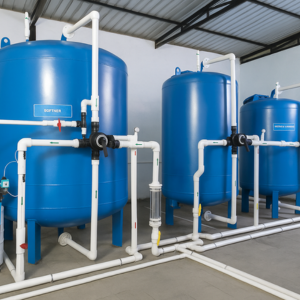
Overview
An ion-exchange softener passes hard water through a bed of strong-acid cation resin, which swaps calcium and magnesium ions for sodium. When the resin is exhausted it is regenerated with brine in a sequence of backwash, brine draw and rinse, triggered either on a timer or by treated volume or hardness. Vessels are offered in FRP, rubber-lined mild steel (MSRL) or stainless steel, with manual, semi-automatic or automatic valves, and larger plants can use a PLC with HMI and alarms.
Where salt use or brine discharge is restricted, catalytic or electro-magnetic conditioners can be considered; these aim to limit scale formation without removing minerals. Brine recovery and an RO polishing loop can be added where discharge is a concern.
Selecting the right softening system
Start from total hardness of the feed, required outlet hardness, peak and average flow, and whether supply must be continuous. Continuous duty normally calls for duplex vessels so one can regenerate while the other is in service. Vessel material depends on water chemistry and site conditions, and regeneration mode depends on how steady the demand is. Brine handling and salt storage also need to be planned.
Range overview
- Types and variants
- Ion-Exchange Softening Plant
- Duplex (Twin-Vessel) Softener
- Salt-Free Catalytic Conditioner
- Electro-Magnetic Softener
- Manual
- Semi-Automatic
- Automatic
- Materials and grades
- FRP
- MSRL (Rubber-Lined Mild Steel)
- SS 316
- Strong-Acid Cation Resin
- Size range
- 500 LPH to 50,000 LPH
- 1 m³/h to 250 m³/h
- Pressure / temperature
- Hardness Reduction From 400 ppm to <50 ppm as CaCO₃ (Stated Example)
- Features
- Automatic Brine Regeneration
- Time- or Hardness-Based Regeneration
- Auto Backwash
- PLC With HMI and Alarms
- Brine Recovery Option
- RO Polishing Loop Option
- Site Survey, Commissioning and Operator Training
Exact specifications depend on the variant, material and size. Confirm ratings and certification against the datasheet or with our engineers before ordering.
Applications
- Boiler Feed Water
- Cooling Tower Make-Up
- Manufacturing Process Water
- RO Pre-Treatment
- ETP Pre-Treatment
Industries
- Power generation
- Textiles
- Food and beverage
- Pharmaceutical
- Chemical
- Automotive
- Dairy
- Paper and pulp
- Petrochemical
- Glass and ceramics
Information that speeds up a quotation
Share what you know. Anything you are unsure of can be marked “not known” — our engineers will help confirm it.
- Feed source
- Flow
- Inlet analysis
- Outlet target
- Recovery
- Site
- Power
- Disposal
- OPEX
Need a datasheet?
Add this family to your enquiry list and mention the variant — we will send the relevant technical documents.
Water treatment
Related and alternative families
Industrial reverse-osmosis water plants
Skid-mounted reverse-osmosis plants that reduce dissolved salts in raw or pre-treated water to produce process water for boiler feed, pharmaceutical formulation, food…
Commercial reverse-osmosis plants
Compact reverse-osmosis plants for offices, schools, hospitals, hotels, restaurants, apartment blocks and packaged drinking water units, sized for commercial demand where a…
Commercial water softening systems
Water softeners and conditioners for hotels, hospitals, apartment blocks, institutions, salons and malls, used to limit limescale in pipework, water heaters, laundry…
Water filtration plants
Engineered water filtration and treatment plants that take raw water from borewells, rivers, lakes or recycled sources through clarification, filtration and disinfection…
Sand and multimedia filtration systems
Pressure sand and multimedia filters that remove suspended solids, silt and turbidity from raw water, used as RO and softener pre-treatment and…
Activated carbon filtration systems
Activated carbon filters that adsorb chlorine, odour, colour and organic compounds from water, commonly installed ahead of RO membranes and in process…
Related solutions and guides
Frequently asked questions
What do you need to size an industrial softener?
Send the total hardness of the feed water (as CaCO₃), the outlet hardness you need, average and peak flow, daily operating hours and whether supply must be uninterrupted. Details of the end use, such as boiler pressure or RO feed, and any restrictions on salt use or brine discharge, help decide between ion exchange and a conditioner.
What is the difference between a softener and a salt-free conditioner?
A softener physically removes calcium and magnesium through ion exchange and needs salt for regeneration. A salt-free or magnetic conditioner does not remove hardness minerals; it aims to change how they behave so that less scale forms. For boiler feed and RO pre-treatment, where measured hardness matters, ion exchange is the usual route.
Ready to specify industrial water softening systems?
Send the details you have — quantities, sizes, drawings or a part number. Unknowns are fine.