
Dust control & spray
Dust suppression at conveyor transfer points
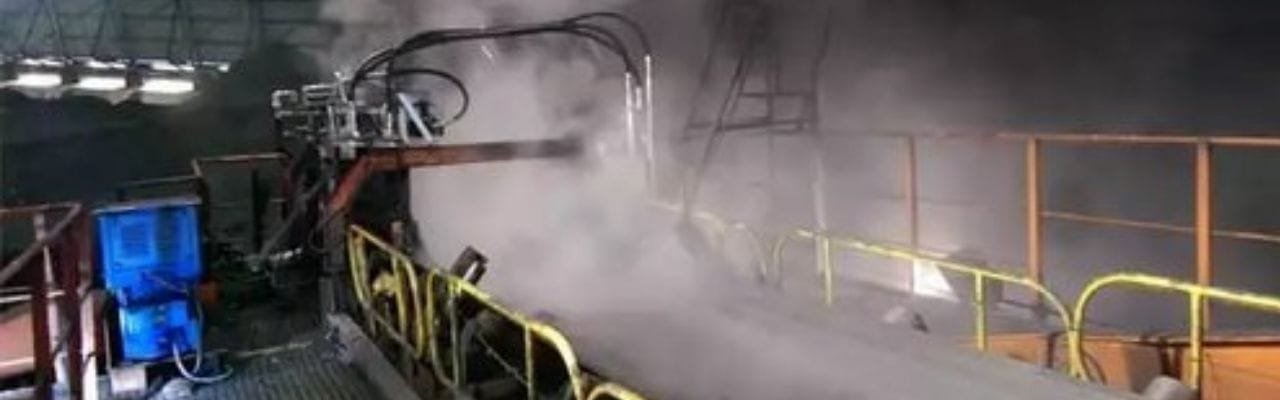
Dust suppression at conveyor transfer points places spray, mist or dry fog nozzles at chutes, loading points and junction towers to control dust where bulk material falls, changes direction or is discharged.
Overview
Transfer points are among the main dust sources in any bulk-handling plant, because falling material entrains air and releases fines. A conveyor dust suppression system mounts nozzles at discharge chutes, loading points, junction towers and crusher outlets, and supplies them with filtered water, or water and compressed air for dry fog. Depending on the material and the degree of enclosure, the system may use plain water sprays, medium-pressure sprays, high-pressure mist or dry fog. High-pressure mist above conveyors can also be used to pre-cool hot material and the belt surface. Activation can be manual, sensor-based, or linked to belt movement or load.
Selecting a transfer point system
Consider the material and its moisture limit, belt width and speed, throughput, drop height, how well the transfer point is enclosed with skirting and hoods, water and compressed-air availability, and how the system should start and stop with the conveyor. Nozzle material and filtration are chosen to suit water quality.
Range overview
- Types and variants
- Plain Water Spray
- Medium-Pressure Spray
- High-Pressure Mist
- Dry Fog
- Materials and grades
- SS 316 Nozzles
- Brass Nozzles
- Features
- Anti-Drip Nozzles
- Multi-Stage Filtration
- Timer, Sensor or PLC Control
- Activation Linked to Belt Movement or Load
- Survey, Design, Installation and Training
- AMC Support
Exact specifications depend on the variant, material and size. Confirm ratings and certification against the datasheet or with our engineers before ordering.
Applications
- Conveyor Transfer Points
- Discharge Chutes
- Loading Points
- Junction Towers
- Crusher Outlets
- Belt and Material Cooling
Industries
- Coal handling
- Cement
- Steel
- Mining
- Ports
- Fertiliser
- Thermal power
- Aggregates
Information that speeds up a quotation
Share what you know. Anything you are unsure of can be marked “not known” — our engineers will help confirm it.
- Dust source
- Material
- Throughput
- Enclosure
- Water
- Compressed air
- Power
- Moisture limit
- Site layout
- Target
Need a datasheet?
Add this family to your enquiry list and mention the variant — we will send the relevant technical documents.
Dust suppression systems
Related and alternative families
Dry fog dust suppression
Dry fog dust suppression uses water and compressed air, atomised together through dry fog nozzles, to create a very fine fog that…
Wet sprinkler dust control
Wet sprinkler dust control applies water through a pressurised pipe network, sprinkler heads or rain guns to wet stockpiles, yards and haul…
Mist dust suppression
Mist dust suppression uses high-pressure pumps and fine misting nozzles to fill the air around a dust source with small water droplets…
Crusher and screening dust suppression
Crusher and screening dust suppression controls dust at jaw, cone, impact and other crushers, screens, hoppers, chutes and stockpiles using water spray,…
Stockyard dust-control sprinklers
Stockyard dust-control sprinklers wet the surface of coal, ore, aggregate and other bulk stockpiles using fixed sprinkler networks, rain guns or fog…
Bulk material unloading dust suppression
Bulk material unloading dust suppression controls dust released at wagon tipplers, track hoppers, ground hoppers and loading points, using dry fog, mist…
Related solutions and guides
Frequently asked questions
What should I send for a conveyor dust suppression quote?
Provide the number and location of transfer points, belt width and speed, material and throughput, drop heights, existing skirting or enclosures, water and compressed-air availability, power supply and how the conveyors are controlled. A conveyor flow sheet and photographs of each transfer point allow us to propose nozzle positions and a control scheme.
Should transfer points use dry fog or high-pressure mist?
Dry fog is generally considered for well-enclosed points handling fine dust where added moisture must be kept low, and it requires compressed air. High-pressure mist uses only water and a pump, and can also help cool hot material or belts. Plain water spray suits coarser material that tolerates wetting. We can review each point individually.
Ready to specify dust suppression at conveyor transfer points?
Send the details you have — quantities, sizes, drawings or a part number. Unknowns are fine.