
Cooling, humidity & air
Misting filters and pre-treatment accessories
Misting filters and pre-treatment accessories remove sediment and limit scale in the water supply to misting and fogging systems, protecting pumps and fine nozzle orifices from blockage.
Overview
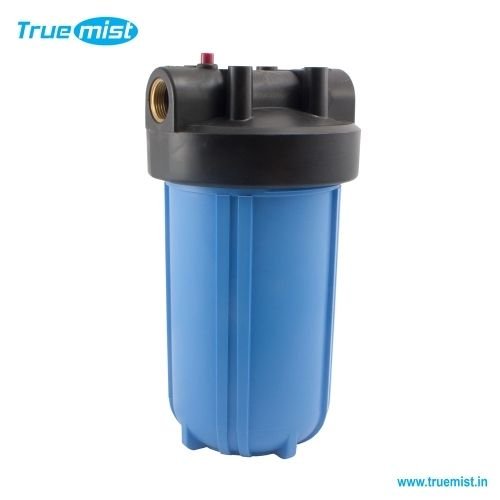
Misting and fog nozzles have very small orifices, so water quality directly affects how well a system runs. Sediment filters in standard and large housings trap sand, rust and debris before the pump, using replaceable cartridge elements. Calcium inhibitor filters treat the water to limit scale build-up in nozzles. Stainless steel high-pressure in-line filters sit after the pump to catch any remaining particles before the nozzle lines.
For larger systems or poor water sources, sediment filtration with media such as sand or anthracite can be added upstream. Filter elements are consumables and should be replaced at intervals that suit the water quality and running hours.
Selecting filtration
Consider the water source and its sediment and hardness, total system flow, pump inlet size, nozzle orifice size, running hours, and how easily elements can be accessed for replacement. A water analysis helps decide whether scale treatment is needed. Where hardness is high, scale treatment should be considered alongside sediment filtration.
Range overview
- Types and variants
- Filter Housing 3/8 in × 10 in
- 20 in Filter Housing With 1-1/2 in Inlet
- 5 µm Filter Element
- Calcium Inhibitor Filter
- Stainless Steel High-Pressure In-Line Filter
- Sediment Media Filter
- Materials and grades
- Stainless Steel (In-Line Filter)
- Size range
- Housing: 3/8 in × 10 in
- Housing: 20 in With 1-1/2 in Inlet
- Filter Element: 5 µm
- Features
- Replaceable Cartridge Elements
- Scale Inhibition
- Post-Pump High-Pressure Filtration
- Sand or Anthracite Media Options
Exact specifications depend on the variant, material and size. Confirm ratings and certification against the datasheet or with our engineers before ordering.
Applications
- Misting Systems
- Fogging Systems
- Humidification Systems
- Dust Suppression Mist Lines
Industries
- Agriculture
- Textiles
- Hospitality
- Warehousing
Information that speeds up a quotation
Share what you know. Anything you are unsure of can be marked “not known” — our engineers will help confirm it.
- Flow rate
- Operating pressure
- Nozzle count
- Water quality
- Control type
Need a datasheet?
Add this family to your enquiry list and mention the variant — we will send the relevant technical documents.
Misting equipment
Related and alternative families
Misting pressure pumps and pump sets
Misting pressure pumps and pump sets supply filtered water at the pressure misting, fogging and dust suppression nozzles need, from low-pressure monoblock…
Mist nozzles and anti-drip assemblies
Mist nozzles and anti-drip assemblies are the fine-orifice nozzles that atomise water in misting and fogging systems, in brass or stainless steel…
Misting tubes, connectors and fittings
Misting tubes, connectors and fittings form the high-pressure lines that carry water from the pump to the nozzles, including stainless steel, copper…
Humidity and temperature controllers
Humidity and temperature controllers switch misting and fogging systems on and off automatically from temperature and humidity readings, and can split large…
Related solutions and guides
Frequently asked questions
Which filters does a misting system need?
Most systems use a sediment cartridge filter before the pump and a high-pressure in-line filter after it. Where water is hard, a calcium inhibitor filter is added to limit scale in nozzles. Very dirty supplies may need media filtration upstream. Share your water source and a water analysis if available.
How often should filter elements be changed?
Replacement intervals depend on water quality, flow and running hours. Pressure gauges across the filter or a visible drop in nozzle performance indicate when an element is loaded. We can suggest a starting interval once we know your water source and operating pattern.
Ready to specify misting filters and pre-treatment accessories?
Send the details you have — quantities, sizes, drawings or a part number. Unknowns are fine.