
Automation & robotics
Industrial sensors and encoders
Industrial sensors and rotary encoders that turn physical conditions and motion into electrical signals for PLCs, drives and counters, covering proximity, photoelectric, pressure, level, temperature, humidity and motion sensing.
Overview
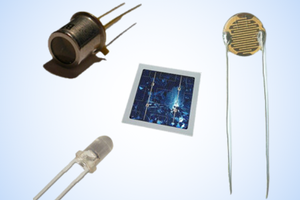
Sensors convert a physical quantity such as light, heat, motion, moisture or pressure into a signal that a controller can read. They may be active, needing an external supply, or passive, and may give an analogue output proportional to the measured value or a digital on/off or networked output. Common industrial types include proximity, photoelectric, pressure, level, temperature, humidity, accelerometer and chemical sensors.
Encoders are feedback devices that convert shaft or linear movement into pulses read by counters, PLCs or drives to determine position, count, speed and direction. Incremental optical encoders use an LED, a patterned code disc and a photodetector; magnetic, mechanical and resistive technologies are also used.
Selecting sensors and encoders
For sensors, define what is being detected or measured, the range and response needed, the target material and distance, the output type the controller accepts, supply voltage, and the environment (dust, washdown, temperature, vibration). For encoders, consider resolution, incremental or absolute output, shaft or hollow-shaft mounting, signal type and cable length to the receiving device.
Range overview
- Types and variants
- Proximity Sensors
- Photoelectric Sensors
- Pressure Sensors
- Level Sensors
- Temperature Sensors
- Humidity Sensors
- Accelerometers
- Incremental Rotary Encoders
- Optical Encoders
- Magnetic Encoders
- Features
- Analogue or Digital Output
- Active and Passive Types
- Pulse Output for Position, Count, Speed and Direction
Exact specifications depend on the variant, material and size. Confirm ratings and certification against the datasheet or with our engineers before ordering.
Applications
- Assembly Line Detection
- Cut-to-Length Feeding
- Crane Load Handling
- Bottle and Jar Filling
- Lift Floor Levelling
- Robotic Welding
- Label Application
- HVAC and Greenhouse Monitoring
Industries
- Manufacturing
- Automotive
- Packaging
- Lifts and elevators
- Agriculture
- Data centres
Information that speeds up a quotation
Share what you know. Anything you are unsure of can be marked “not known” — our engineers will help confirm it.
- Brand approval
- Power
- Voltage
- Phase
- I/O count
- Communication
- Environment
- Certification
Need a datasheet?
Add this family to your enquiry list and mention the variant — we will send the relevant technical documents.
Electrical and controls
Related and alternative families
AC drives and VFDs
AC drives and variable frequency drives (VFDs) that control the speed and torque of AC motors by varying supply frequency and voltage,…
AC motors and gear motors
AC induction motors and geared motors that combine a motor with an integrated gearbox to deliver reduced speed and higher torque, for…
Servo drives and servo motors
Servo drives and brushless servo motors for closed-loop control of position, speed and torque on machines, robots and positioning systems where accurate,…
Programmable logic controllers
Programmable logic controllers (PLCs) and related controllers that read inputs from sensors and switches, run user-written logic and drive outputs to motors,…
Human-machine interfaces
Human-machine interfaces (HMIs), from machine-mounted operator panels to monitors and tablets, that let operators view process data, track production, adjust settings and…
Industrial switchgear
Low-voltage industrial switchgear, including disconnect switches, fuses and circuit breakers, used to isolate electrical equipment safely for maintenance and to clear faults…
Frequently asked questions
What information is needed to choose a sensor?
Describe what needs to be detected or measured, the target material and sensing distance or range, the speed of the process, the output signal your PLC or controller accepts, the supply voltage, and the mounting and environmental conditions. Photographs of the mounting point help when space is tight.
Should I use an incremental or absolute encoder?
An incremental encoder outputs pulses as the shaft moves, so the controller counts from a reference point and must re-home after power loss. An absolute encoder reports a unique position at all times, including after power-up. Absolute types suit positioning where re-homing is impractical; incremental types are simpler for speed and count measurement.
Ready to specify industrial sensors and encoders?
Send the details you have — quantities, sizes, drawings or a part number. Unknowns are fine.