
Water treatment
Water recycling and reuse systems
Water recycling plants that treat used water from industrial, commercial and municipal sources to a reusable standard for cooling tower make-up, process washing, irrigation and dust suppression.
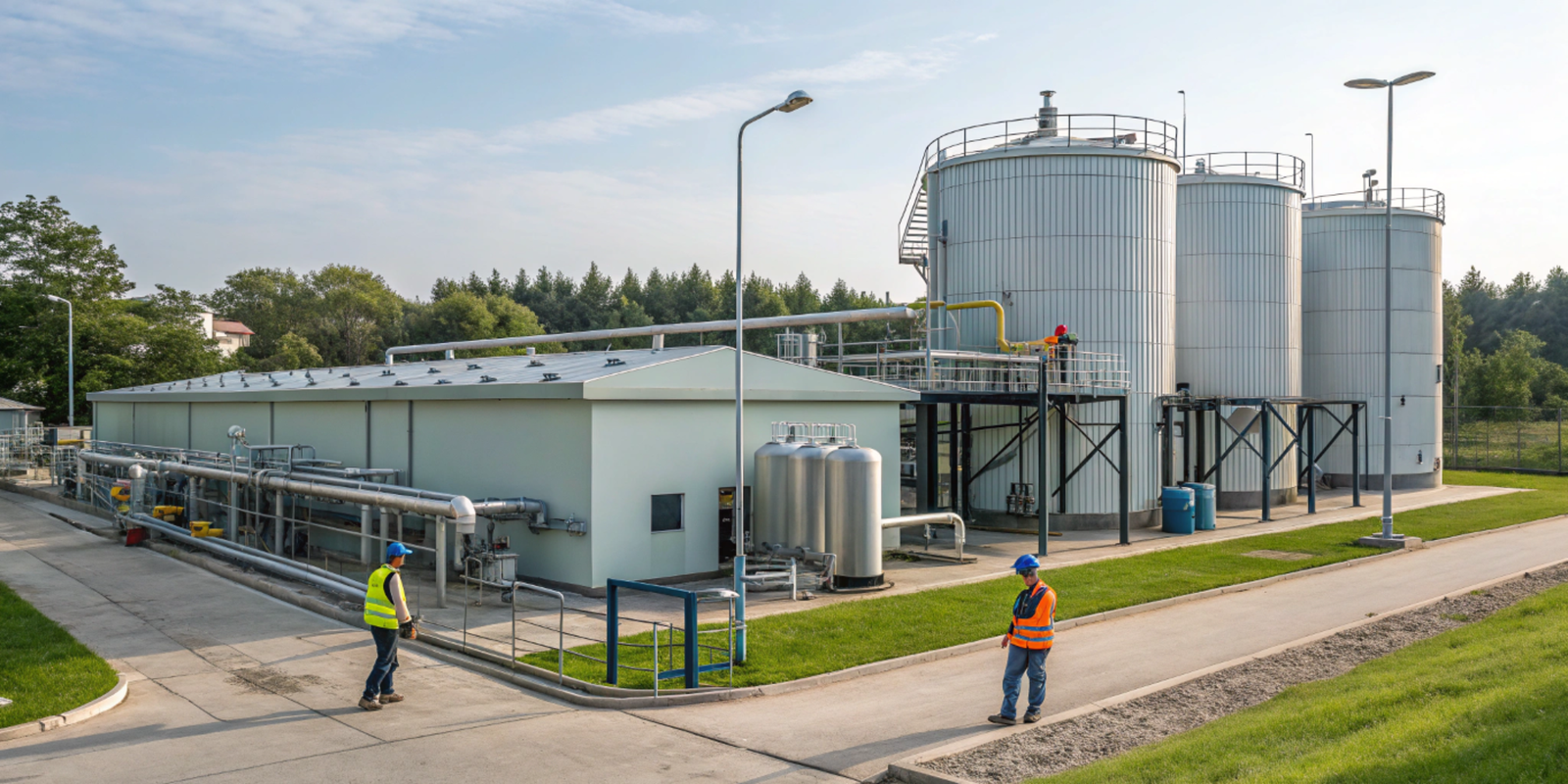
Overview
A recycling plant combines primary, biological and tertiary treatment. Screening, grit removal and equalisation are followed by primary clarification with tube or lamella settlers, biological treatment by aerated lagoon, extended aeration, MBBR or SBR, then tertiary sand or dual-media filtration and ultrafiltration, finishing with UV or chlorination. Plants can be compact skids or fully integrated installations. Controls can run on PLC or SCADA with remote monitoring, and the design can be left ready for a later RO and evaporator stage if the site moves towards zero liquid discharge.
Selecting a recycling plant
Define the source water (sewage, greywater or industrial wastewater) and its contaminants, the volume available each day, and the quality needed for each reuse. Cooling tower and boiler uses need tighter limits than landscaping. Footprint, power, sludge handling and the possibility of adding stages later should be considered at the outset.
Range overview
- Types and variants
- Compact Skid-Mounted Recycling Plant
- Integrated Recycling Installation
- ZLD-Ready Design With RO and Evaporator Option
- Size range
- 1,000–40,000 LPH
- Custom up to 250 m³/h
- Footprint About 20 m² (1 KLD) to 600 m² (1 MLD)
- Pressure / temperature
- Design Inlet TSS up to 500 mg/L
- Design Inlet BOD₅ up to 350 mg/L
- Features
- Tube or Lamella Settlers
- Biological Treatment Options
- Dual-Media and UF Tertiary Filtration
- UV or Chlorine Disinfection
- VFD Blowers
- PLC/SCADA With Remote Monitoring
- Modular Upgrades
Exact specifications depend on the variant, material and size. Confirm ratings and certification against the datasheet or with our engineers before ordering.
Applications
- Cooling Tower Make-Up
- Boiler Feed After Further Treatment
- Process Wash Water
- Irrigation
- Dust Suppression
Industries
- Manufacturing
- Municipal
- Commercial buildings
- Agriculture
- Pharmaceutical
- Healthcare
Information that speeds up a quotation
Share what you know. Anything you are unsure of can be marked “not known” — our engineers will help confirm it.
- Feed source
- Flow
- Inlet analysis
- Outlet target
- Recovery
- Site
- Power
- Disposal
- OPEX
Need a datasheet?
Add this family to your enquiry list and mention the variant — we will send the relevant technical documents.
Water treatment
Related and alternative families
Industrial reverse-osmosis water plants
Skid-mounted reverse-osmosis plants that reduce dissolved salts in raw or pre-treated water to produce process water for boiler feed, pharmaceutical formulation, food…
Commercial reverse-osmosis plants
Compact reverse-osmosis plants for offices, schools, hospitals, hotels, restaurants, apartment blocks and packaged drinking water units, sized for commercial demand where a…
Industrial water softening systems
Ion-exchange softening plants and salt-free conditioners that remove or control calcium and magnesium hardness in process water, protecting boilers, cooling towers, process…
Commercial water softening systems
Water softeners and conditioners for hotels, hospitals, apartment blocks, institutions, salons and malls, used to limit limescale in pipework, water heaters, laundry…
Water filtration plants
Engineered water filtration and treatment plants that take raw water from borewells, rivers, lakes or recycled sources through clarification, filtration and disinfection…
Sand and multimedia filtration systems
Pressure sand and multimedia filters that remove suspended solids, silt and turbidity from raw water, used as RO and softener pre-treatment and…
Frequently asked questions
What do you need to assess a water recycling project?
Send the source of the used water, its daily volume, recent analyses (TSS, BOD, COD, oil, TDS), and a list of the intended reuse points with the quality each needs. Site layout, available space, and any existing treatment units that could be retained also help in working out a practical treatment train.
Can a recycling plant be upgraded later?
Yes, plants can be laid out so that further stages, such as RO and an evaporator for zero liquid discharge, can be added later. Allowing space, pipe connections and electrical capacity at the start makes such an upgrade simpler. Discuss likely future requirements during design so they are reflected in the layout.
Ready to specify water recycling and reuse systems?
Send the details you have — quantities, sizes, drawings or a part number. Unknowns are fine.