
Fluid, piping & valves
Thermowells and fittings
Thermowells that protect temperature sensors from process pressure, flow and corrosion and let sensors be replaced without draining the line, machined straight, tapered or stepped with threaded, flanged or weld-in connections.
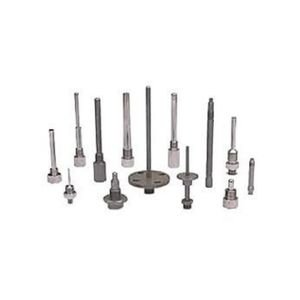
Overview
A thermowell is a closed-end tube machined from bar or pipe that sits in the process stream and houses a thermocouple, RTD or thermometer. Because the well holds the process pressure, the sensor can be withdrawn for calibration or replacement while the plant runs. Straight wells are simplest; tapered and stepped profiles stiffen the well and improve response time. Materials include SS 304/304L, SS 316/316L, super duplex and nickel alloys. Connections are threaded, flanged, socket-weld or weld-in. Listed products include heavy-duty wells for coal mills and abrasive service, 1/2 in threaded wells and super duplex wells from 1/2 in to 2 in.
Selecting a thermowell
Choose the material for the process media and temperature, the profile for flow velocity and response, and the process connection to match the nozzle. Immersion length is commonly set so the tip sits in the representative part of the stream; a frequently used guide is one-third to two-thirds of the way into the pipe.
Range overview
- Types and variants
- Straight Thermowells
- Tapered Thermowells
- Stepped Thermowells
- Threaded Thermowells
- Flanged Thermowells
- Super Duplex Thermowells
- Heavy-Duty Thermowells for Abrasive Service
- Materials and grades
- SS 304/304L
- SS 316/316L
- Super Duplex Stainless Steel
- Monel
- Hastelloy C
- Size range
- 1/2 in to 2 in
- Threaded: 1/2 in
- Connections and interfaces
- Threaded
- Flanged
- Socket-Weld
- Weld-In
- Features
- Machined Straight, Tapered or Stepped
- Sensor Replacement Without Draining the Line
Exact specifications depend on the variant, material and size. Confirm ratings and certification against the datasheet or with our engineers before ordering.
Applications
- Temperature Sensor Protection
- Coal Mills and Abrasive Service
- Process Temperature Measurement
Industries
- Refining
- Petrochemical
- Chemical
Information that speeds up a quotation
Share what you know. Anything you are unsure of can be marked “not known” — our engineers will help confirm it.
- Nominal size
- Pressure class
- Material
- End connection
- Standard
- Temperature
- Media
- Drawing
- Certification
Need a datasheet?
Add this family to your enquiry list and mention the variant — we will send the relevant technical documents.
Piping and hydraulic connections
Related and alternative families
Pipe fittings and flanges
Pipe fittings and flanges for process and utility piping, from butt-weld and forged fittings to slip-on, weld-neck, blind and threaded flanges, in…
Stainless steel butt-weld fittings
Stainless steel butt-weld pipe fittings, including bends, elbows, crosses and stub ends, for changing direction, branching or reducing welded process piping in…
Forged threaded and socket-weld fittings
Forged socket-weld and threaded pipe fittings for small-bore process lines, including elbows, couplings, half couplings, connectors, outlets and nipples in stainless, duplex…
Stainless steel seamless pipes and tubes
Stainless steel seamless and welded pipes and tubes for hydraulic, instrumentation and process lines, in 304 and 316 grades, with pickled, polished…
Hydraulic SAE flanges
Hydraulic SAE four-bolt flanges in Code 61 and Code 62 patterns, with one-piece flanges and split flange clamps for connecting hose ends,…
Hydraulic tube clamps
Hydraulic tube clamps in light, heavy and double-hole series for supporting and securing hydraulic tube and pipe runs, with polypropylene or polyamide…
Related solutions and guides
Frequently asked questions
How long should a thermowell be?
The tip should sit where the process temperature is representative, away from the wall. A common guide is one-third to two-thirds of the way into the stream, or about ten times the tip diameter, with a practical minimum of around 50 mm. Longer wells in high-velocity flow need checking for vibration.
What details should I send for a thermowell quote?
Give the sensor diameter, immersion and overall length, process connection type and size, profile (straight, tapered or stepped), material, process pressure, temperature, flow velocity and media. A datasheet or drawing is ideal. You can request material certificates and pressure test records.
Ready to specify thermowells and fittings?
Send the details you have — quantities, sizes, drawings or a part number. Unknowns are fine.