
Fluid, piping & valves
Condensate pots and air headers
Condensate pots for steam and vapour impulse lines and air headers for distributing instrument air, in carbon steel, mild steel and stainless steel, with multi-way outlet options and drain connections.
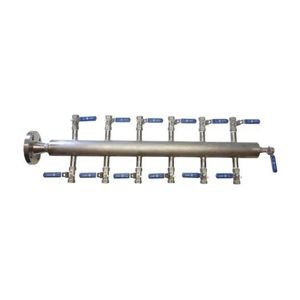
Overview
A condensate pot is fitted in the impulse line between a steam or vapour tapping and the instrument. It collects condensate so that the gauge or transmitter sees a stable liquid column instead of hot vapour, which protects the instrument and helps keep the hydrostatic head equal on both legs of a differential measurement. A typical pot is a horizontal pipe section of about 4 in diameter with inlet connections and a bottom drain port suitable for a valve.
Air headers take instrument air from one inlet and distribute it to several outlet valves, in 2, 4, 8 and 16-way versions from 1/4 in to 2 in. Options include selector switches and gauge savers.
Selecting condensate pots and headers
For condensate pots, give the process pressure and temperature, the impulse line connections and whether a drain valve is needed. For air headers, specify the number of outlets, inlet and outlet sizes, valve type, material and supply pressure, plus any options such as a gauge, drain valve or selector switch.
Range overview
- Types and variants
- Carbon Steel Condensate Pots
- Mild Steel Condensate Pots
- Stainless Steel Condensate Pots
- Condensate Seal Pots
- Steam Condensate Pots
- Air Headers 2, 4, 8 and 16 Way
- Carbon Steel Air Headers
- Materials and grades
- Carbon Steel
- Mild Steel
- SS 304
- Stainless Steel
- Nickel Alloys (Air Headers)
- Size range
- Condensate Pot: Approx. 4 in Diameter Pipe Section
- Air Headers: 1/4 in to 2 in
- Pressure / temperature
- Air header: 0 to 6000 psi
- Air header: 100 °C working temperature
- Connections and interfaces
- Inlet Connections to Requirement
- Bottom Drain Port
- Per Client Requirement
- Features
- Multi-Way Outlet Options
- Drain Port for Valve
- Selector Switch and Gauge Saver Options
Exact specifications depend on the variant, material and size. Confirm ratings and certification against the datasheet or with our engineers before ordering.
Applications
- Steam Flow and Level Measurement
- Protecting Gauges and Transmitters
- Instrument Air Distribution
Industries
- Refining
- LPG processing
- Power generation
- Steel
- Pulp and paper
- Food processing
- HVAC
Information that speeds up a quotation
Share what you know. Anything you are unsure of can be marked “not known” — our engineers will help confirm it.
- Nominal size
- Pressure class
- Material
- End connection
- Standard
- Temperature
- Media
- Drawing
- Certification
Need a datasheet?
Add this family to your enquiry list and mention the variant — we will send the relevant technical documents.
Piping and hydraulic connections
Related and alternative families
Pipe fittings and flanges
Pipe fittings and flanges for process and utility piping, from butt-weld and forged fittings to slip-on, weld-neck, blind and threaded flanges, in…
Stainless steel butt-weld fittings
Stainless steel butt-weld pipe fittings, including bends, elbows, crosses and stub ends, for changing direction, branching or reducing welded process piping in…
Forged threaded and socket-weld fittings
Forged socket-weld and threaded pipe fittings for small-bore process lines, including elbows, couplings, half couplings, connectors, outlets and nipples in stainless, duplex…
Stainless steel seamless pipes and tubes
Stainless steel seamless and welded pipes and tubes for hydraulic, instrumentation and process lines, in 304 and 316 grades, with pickled, polished…
Hydraulic SAE flanges
Hydraulic SAE four-bolt flanges in Code 61 and Code 62 patterns, with one-piece flanges and split flange clamps for connecting hose ends,…
Hydraulic tube clamps
Hydraulic tube clamps in light, heavy and double-hole series for supporting and securing hydraulic tube and pipe runs, with polypropylene or polyamide…
Related solutions and guides
Frequently asked questions
Why is a condensate pot needed on steam measurement lines?
Steam reaching a transmitter directly can overheat it and causes unstable readings as it condenses unevenly. A condensate pot fills with condensate that forms a stable liquid seal, so the instrument sees water at a manageable temperature and both legs of a differential measurement hold a matched liquid head.
What should an air header enquiry include?
State the number of outlets, inlet and outlet sizes and thread types, the type of outlet valve, header material, supply pressure and any options such as a gauge or drain. Mounting details and quantity complete the enquiry. For condensate pots, give the process pressure and temperature and the connection sizes.
Ready to specify condensate pots and air headers?
Send the details you have — quantities, sizes, drawings or a part number. Unknowns are fine.